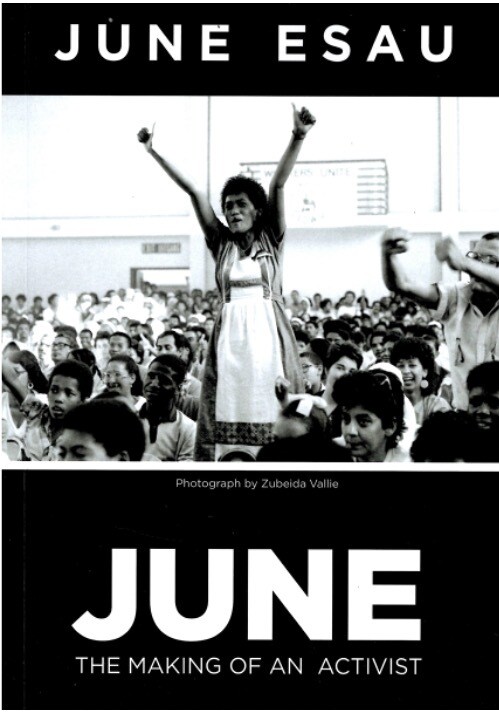
June Esau - JUNE - The Making of an Activist
R250.00
Sold out
Sold out
Product Details
June, the making of an activist tells of a young girl growing up in a segregated society, initially oblivious of the wider social and political environment. It is the late 1960s and early 1970s, and opinions critical of the apartheid state are expressed in hushed tones.
Esau, the only girl among four siblings, was born and bred in Worcester in the Boland. Before they moved to government subeconomic housing, the family initially lived in relatively distressed circumstances by candlelight with communal washing and ablution facilities.
From early on, her parents inculcated the siblings with social values that stood them in good stead; what mattered were not material goods but character, honesty, reliability and caring about ‘the welfare of others’.
As she gets drawn into building the trade union movement in the 1980s, her irrepressible character, sense of fairness and justice, and organisational flair and leadership qualities find expression in these spaces and organisations. It is also an exhilarating period, ‘the time of the UDF and there was no going back. We were unstoppable and we were marching forward all the time’.
This is a book of coming into being: personally, socially, and politically. Some of the more instructive anecdotes are those of activism, of empowerment, of galvanising political organisation and the honing of leadership. But activism against an oppressive state also draws the attention to those bent on preserving it.
Esau recounts her rape as a young woman – ‘an evil act… and painful memory’ – in a relative’s house that left her doubting her sense of her dignity. This act of abuse is a precursor to the dehumanisation and unrelenting violence of the security police members in later years.
She describes in vivid detail her interrogation at the hands of members of the police, who were sometimes drunk but always sadistic and brutal. These are some of the more heart-rendering parts of Esau’s life story. It is a story of survival. ‘I am sharing my story… as a survivor of Apartheid rather than a victim,’ she writes.
This is a book of courage, sacrifice, and commitment to bring about a better world, just as it is a book of homage and gratitude. Throughout Esau thanks those comrades and friends who assisted her on her journey to find her place in the world. One section is entitled ‘Sisterhood’, and it is indeed a book of sisterhood, the women from various backgrounds who share her trials, who look after her children when she is detained, who provide clothes, a warm bed and a meal when she was destitute.
Quite often the story of political struggle is told as the story of great men, and the activism of the workers on the shop-floor; the marchers in the streets and commitment of the foot soldiers are mostly forgotten. This slim volume, less than 100 pages, reminds us timeously that ordinary workers and committed working-class organisers greatly contributed to our democratic dispensation.
Esau’s tale is remarkable in its own right, but it is necessary to mention that her brothers Japie and Cecil also spent time in prison for their political commitment. Cecil, the youngest brother, endured several spells of detention and served a prison sentence on Robben Island. Cecil’s summation of her life story is apt: ‘Your life has been more militant and inspiring [than mine]! You don’t need to play small! You can walk tall as one who has given your all and committed to the worker and national liberation!’
June Esau’s autobiography is a valued contribution to our record of political and activist biographies and autobiographies written since the dawn of democracy. The book is self-published and available from the author at themakingofanactivist@gmail.com.
Hein Willemse is professor in the Department of Afrikaans at the University of Pretoria.
Save this product for later
Display prices in:ZAR